
While classrooms and hallways often receive the spotlight when it comes to student safety, there’s another area on campus where danger lurks far too often—the parking lot. For many schools across the country, this space has become a source of growing concern. With hundreds of cars, buses, and pedestrians converging in the same location within a narrow timeframe each day, school parking lots can quickly become chaotic and, in some cases, hazardous.
What makes this issue especially concerning is how easy it is to overlook. After all, these areas aren’t typically thought of as “high risk” zones. But the reality is that without thoughtful design and structured protocols, parking lots can put students, staff, and families in harm’s way.
The Reality on the Ground
A typical school day begins and ends with a rush of movement. Parents pulling in to drop off children, buses arriving on schedule, staff trying to park, and students walking or biking to class—all these movements converge in a confined space within just 30 to 60 minutes. In this tight window, confusion and congestion reign.
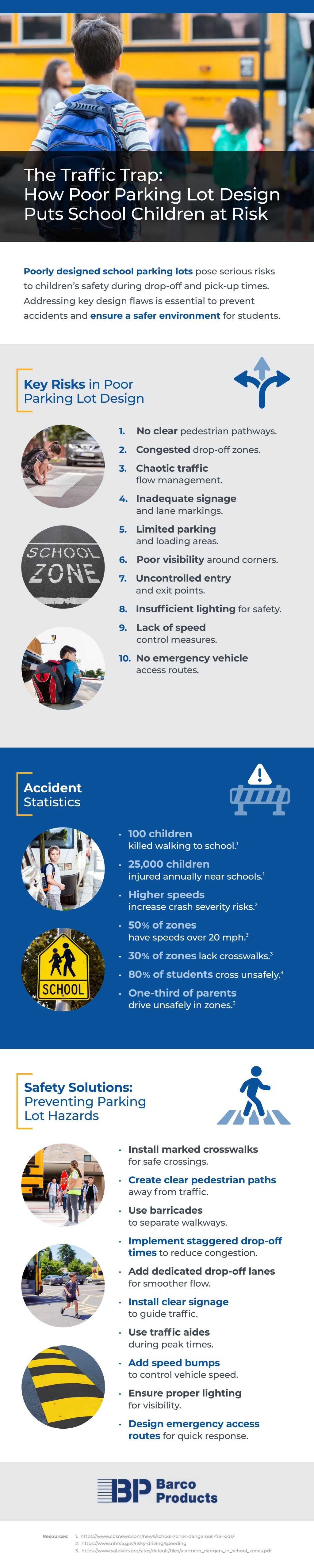
The most common issues include:
- Double-parking and illegal stops, which force students to cross active lanes of traffic.
- Lack of separation between vehicles and pedestrians, making it difficult for drivers to anticipate foot traffic.
- Poor signage or faded lane markings, leading to unclear directionality and erratic driver behavior.
- Inadequate crosswalks or crossing guards, particularly in larger school zones with multiple entry points.
- Speeding vehicles, often from parents running late or unfamiliar with school zone protocols.
These are not small problems—they are systemic ones that, when left unchecked, contribute to an environment where accidents are far more likely to happen.
Data That Can’t Be Ignored
According to national safety data, hundreds of children are injured each year in school-related traffic incidents, and many of these accidents occur in or near parking areas. Alarmingly, a significant number of school zones still lack essential safety features like visible crosswalks, posted speed limits, or physical barriers that separate vehicles from pedestrians.
Moreover, surveys reveal that a concerning portion of traffic violations in school zones are committed by parents themselves—highlighting the need for more education and better enforcement during drop-off and pick-up periods.
Simple Fixes With Big Impact
The good news is that improving parking lot safety doesn’t always require major construction or a complete redesign. Small, targeted changes can drastically reduce risk and improve flow. These include:
- Clear visual cues such as directional arrows, painted lanes, and reflective signage to guide drivers.
- Physical barriers or bollards to separate walkways from drive lanes.
- Designated waiting zones that keep parked vehicles out of active traffic lanes.
- Use of crossing guards or volunteers to help manage foot traffic during peak times.
- Speed cushions or rumble strips to force slower vehicle speeds in pedestrian-heavy zones.
Technology can also play a role. Surveillance cameras and automated signage can help monitor driver behavior and reinforce school zone rules in real time.
A Safer Environment Starts Outside the Classroom
Creating a secure, structured environment doesn’t stop at the school’s front door. Parking lot safety equipment, design, signage, and protocols are just as important to student safety as in-class emergency planning or fire drills. These outdoor spaces should be treated as part of the school’s overall safety infrastructure, not as an afterthought.
Ultimately, school parking lots should reflect the same level of care, planning, and accountability that goes into educating students. By giving these high-traffic areas the attention they deserve, schools can better protect students and create a safer, more organized experience for everyone involved.
 |
