
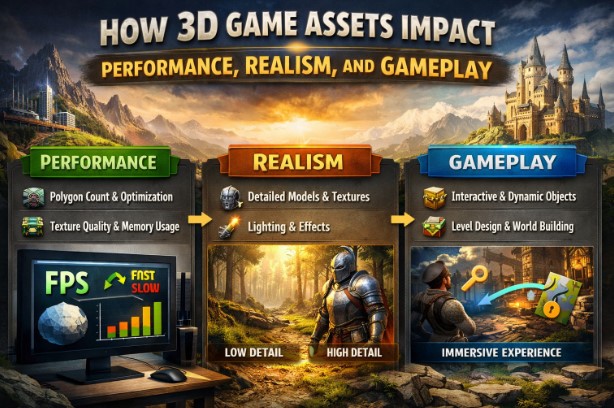
Modern games are not only evaluated by their playability but also by the quality of their performance and how realistic the game worlds are. Whichever platform players use to play, visually appealing environments with realistic characters and responsive interactions are in order.
Standing behind all these expectations is a very important foundation: 3D game assets. Such assets affect performance optimization, visual realism, and gameplay design more deeply than many players realize.
Understanding how asset quality affects these three pillars is critical for game studios seeking to build successful, scalable, and competitive titles.
The Relationship between Assets and Game Performance
One of the most sensitive aspects of the player experience is performance. Frame drops, long load times, and stuttering quickly frustrate players, even if a game looks impressive. Asset quality plays a direct role in how efficiently a game runs.
Well-optimized assets are based on clean geometry to have a good balance of polygon counts and efficient use of textures. This enables the rendering of scenes inside a game engine without overloading the GPU or CPU. Poorly optimized assets will lead to memory spikes, excessive draw calls, or unstable frame rates.
Key performance benefits from optimized assets include:
- Smooth frame rates during demanding gameplay
- Faster scene loading and level transitions
- Reduced memory consumption across platforms
Early asset optimization planning by developers avoids expensive reworks late into the production cycle.
Realism through Visual Detail and Consistency
Realism is not always about photorealism in games. The quality of assets directly influences how convincing characters, environments, and objects appear on screen.
High-quality assets have proper proportions, correct surface details, and materials that respond naturally to lighting. Proper use of normal maps, roughness, and texture resolution adds depth without excessive geometry.
Consistency across assets helps:
- Immersion during the whole game
- Avoid visual distractions resulting from unmatched styles
- Enhance the artistic identity of the game
3D game assets are the visual language with which the game world speaks to players in the main pipeline of production.
Impact on Gameplay Readability
Gameplay depends a great deal on visual clarity. It should be easy for a player to make out instantly if there is a character, an enemy, an interactive object, or a hazard present, especially in very fast action genres. Asset design directly impacts the readability when a game is played.
Clear contours, silhouettes, and judicious color contrast help players make swift decisions.
Badly designed assets result in confusion, missed interactions, or unfair moments in gameplay.
- Asset-driven gameplay clarity supports
- Improved player navigation and spatial awareness
- Faster reaction times in combat or challenges
- More intuitive interaction with the environment
When designed with gameplay in mind, assets amplify both visual appeal and mechanical precision.
Animation and Interaction Quality
Assets are directly tied to animation quality. Clean topology and good rigging mean that characters and objects move naturally. Poorly constructed models often result in stiff animations or awkward deformations/clipping issues that break immersion.
Smooth animations enhance:
- Character responsiveness
- Combat fluidity
- Overall Game Feel
Other interactive objects, such as doors, weapons, and environmental elements, also require proper asset construction to behave correctly within the game engine.
Cross-Platform Performance Considerations
With most of the games released on different versions today, the mainstays are PC, console, and mobile; each has different performance constraints, so optimization of assets is important.
Assets should be scalable so developers can adjust the level of detail, texture resolution, and other forms of complexity to support a range of hardware capabilities. Consistency in gameplay experiences is assured without the creation of separate asset pipelines for every platform.
Scalable assets help:
- Maintain visual quality on high-end systems
- Make sure the game is playable on lower-end machines
- Reduce production overhead
Worldbuilding and Environmental Storytelling
Environmental storytelling has become increasingly dominant in games, rather than direct exposition. Assets with embedded visual details can successfully convey the narrative elements in a subtle manner.
By carefully designing the assets, developers can:
- Show history through worn textures and damaged structures.
- Suggest culture through architecture and props.
- Use lighting and the composition of the environment to create an emotional atmosphere.
This helps players discover the story themselves organically and thus makes the experience so much more interesting and immersive.
Development Efficiency and Production Stability
Asset quality also influences the efficiency of development. The cleaner and more well-structured the assets, the easier it is to update, reuse, and modify as the project evolves.
Studios that use professional 3D modeling services usually have standardized workflows, predictable quality, and assets that fit seamlessly into modern engines. This reduces friction between the art and development teams and keeps production on schedule.
Efficient assets contribute towards:
- Faster iteration cycles
- Fewer late-stage technical issues
- More predictable development timescales
- Long-term scalability and live updates
Reusable asset libraries allow teams to:
- Ensure updating maintains visual consistency
- Lower costs for new content
- Increase the speed of production for expansions and sequels
By planning your assets for long-term use, the game will remain visually cohesive as content continues to grow.
Player Perception & Market Competitiveness
Visual quality plays an important role in the value perception of the game by the players. Assets are crucial in making a great first impression in store listings, trailers, and promotion materials.
High-quality visuals help:
- Increase player trust before purchase
- Enhancing Marketing Performance
- Support a stronger brand identity
Conclusion
Performance, realism, and gameplay are closely interconnected, and it all starts with asset quality. Well-designed 3D game assets would definitely provide for smooth performance, believability of the worlds, and clear, engaging gameplay experiences across platforms.
