
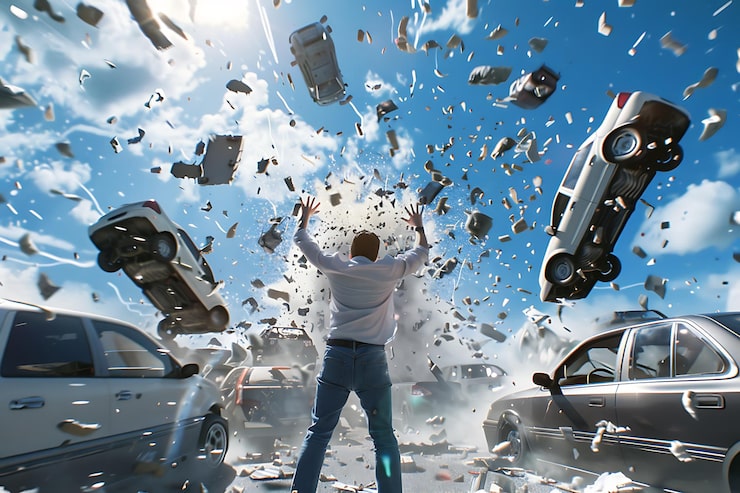
When two cars collide, it may feel like chaos – but in reality, every movement, every force, and every outcome is governed by the unbreakable laws of physics. From the moment of impact, energy transfer and force distribution take over, following principles first described by Sir Isaac Newton more than 300 years ago.
Understanding these concepts doesn’t just explain crashes – it also reveals why modern safety features like seat belts, airbags, and crumple zones save lives.
Kinetic Energy: The Hidden Force Behind Every Crash
Before a collision even happens, both vehicles carry kinetic energy, which is the energy of motion. The faster and heavier a car is, the more energy it carries.
When a crash occurs, that energy doesn’t disappear – it must go somewhere.
-
It transfers between vehicles
-
It deforms metal (crumpling)
-
It becomes heat and sound
-
It is ultimately absorbed by the occupants if not properly managed
In fact, during a collision, “kinetic energy will suddenly transfer to the opposing vehicle or object it strikes.”
This rapid energy transfer is what makes collisions so dangerous – and why controlling that energy is the key to safety.
Newton’s First Law: The Law of Inertia
Newton’s First Law states that an object in motion will stay in motion unless acted upon by an external force.
Object in motion stays in motion unless acted upon by a force
In a car crash, this law explains one of the most critical dangers: your body keeps moving even when the car stops.
-
The car hits another object and rapidly decelerates
-
Your body continues moving forward at the same speed
-
A seat belt or airbag provides the force needed to stop you safely
Without that restraining force, occupants can continue moving forward into the dashboard or windshield.
This is why seat belts are not optional – they directly counter inertia.
Newton’s Second Law: Force = Mass × Acceleration
Newton’s Second Law explains how force works during a collision.
F=ma
This equation tells us that:
-
More speed = greater acceleration (or deceleration)
-
More mass = greater force during impact
In practical terms:
-
A fast-moving car creates a more violent crash than a slow one
-
A heavier vehicle (like a truck) generates more force than a small car
That’s why high-speed collisions are so dangerous – the forces involved increase dramatically as speed rises
Modern vehicles are designed with crumple zones to reduce force. These zones:
-
Extend the time of impact
-
Reduce acceleration (and therefore force)
-
Absorb energy before it reaches passengers
By increasing the time over which a crash occurs, the force felt by occupants is reduced – directly applying Newton’s Second Law
Newton’s Third Law: Equal and Opposite Forces
Newton’s Third Law states that every action has an equal and opposite reaction.
In a car crash:
-
Car A pushes on Car B
-
Car B pushes back on Car A with equal force
Even if one car is larger or heavier, the forces between them are equal in magnitude
So Why Does the Smaller Car Take More Damage?
The difference comes down to acceleration and mass:
-
The smaller car experiences greater acceleration
-
Greater acceleration = more severe motion changes
-
This leads to more damage and higher injury risk
In short: same force, different outcomes.
The Three Collisions That Happen in Every Crash
Most crashes actually involve three separate collisions:
-
Vehicle vs. vehicle – the external impact
-
Body vs. vehicle interior – occupants hitting the inside
-
Internal organs vs. body – forces inside the human body
Each stage involves energy transfer, and each can cause injury if not properly managed.
Why Physics Saves Lives
Car safety engineering is essentially applied physics. Every feature is designed to manage energy and reduce force:
-
Seat belts: Stop your body gradually (counter inertia)
-
Airbags: Spread force over time and area
-
Crumple zones: Absorb energy before it reaches you
-
Vehicle structure: Direct forces away from passengers
The goal is simple: Slow down the energy transfer and reduce the force on the human body.
When two cars collide, it’s not random – it’s physics in action. Energy is transferred, forces are exchanged, and motion changes instantly, all governed by Newton’s Laws.
Understanding the physics of a car crash highlights an important truth: Crashes can’t be avoided by physics – but injuries can be reduced by respecting it.
That’s why slowing down, wearing a seat belt, and driving safely aren’t just good habits – they’re ways to work with the laws of motion, not against them.
