
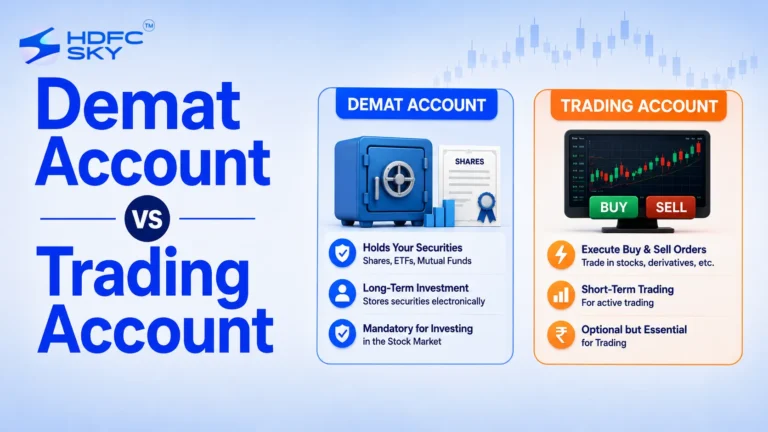
When a brokerage house advertises a demat account with zero annual maintenance charges, it feels like a straightforward win. You imagine saving a few hundred rupees every year while still holding shares, bonds, and mutual fund units in a single electronic space. After all, a demat account is just a digital locker – an alternative to paper certificates that NSDL and CDSL maintain, with a Depository Participant acting as your gateway. The promise of “free” can be the final nudge a new investor needs. However, a demat account’s real cost is never just about the AMC. Frequently, the word “free” works as a spotlight, spotlighting one figure while masking other costs. It’s helpful to know exactly what you are getting and what is discreetly left on your bill before you join up.
What Zero AMC Covers—and What It Ignores
The moment you decide to open free demat account, the immediate gain is that you won’t be charged a yearly fee to maintain your holdings. Zero AMC means the provider does not debit that fixed annual amount, whether you hold ten shares or a thousand. For a small investor, this can keep the first few years genuinely affordable. Yet the account still involves costs that are simply labeled differently. Brokerage on trades, transaction charges levied by the exchange, stamp duty, GST, and SEBI turnover fees all remain applicable. Some platforms even charge a flat fee per debit transaction when you sell or transfer shares out of your demat. The zero AMC tag, therefore, addresses only one line item in a multi-layered cost structure. It only removes the maintenance charge, allowing the other expenses to continue functioning in the background, thus the account is not actually free.
The Fine Print That Affects Your Portfolio
The relationships between a free demat account and the Basic Services Demat Account architecture is another issue that is commonly neglected. SEBI introduced the BSDA concept in 2012 to cap maintenance charges for retail investors whose portfolio value stays under a certain threshold. Many zero AMC offers are actually BSDAs by another name. Under this structure, if your holdings cross the defined value limit – currently up to ₹2 lakh for no charge, and a reduced fee for portfolios between ₹2 lakh and ₹8 lakh – the zero AMC benefit may quietly vanish. Investors who accumulate shares gradually can wake up to an AMC invoice the year they cross the invisible line, simply because their portfolio grew. The free label, therefore, is conditional and size-sensitive, not permanent.
A Quick Checklist of Real Costs
When you open free demat account, evaluate it on the complete cost picture rather than the AMC alone. A practical way to do this is to list all possible charges side by side before opening the account. Here are the elements that add to your total expense even in a zero AMC setup:
|
Cost Component |
What It Means for You |
|---|---|
|
Account opening fee |
Often zero, but some DPs still charge a one-time setup fee. |
|
Trading brokerage |
Charged per trade; delivery trades may be free, intraday and F&O attract a fee. |
|
Transaction charges |
Exchange and clearing corporation fees per trade, passed on to you. |
|
DP debit charges |
A flat fee each time you sell or transfer securities from the demat. |
|
GST and stamp duty |
Government levies applied on brokerage and transaction value. |
|
Inactivity fee |
Some platforms charge if no trades are executed for a specified period. |
|
AMC after threshold |
If BSDA limits are exceeded, annual maintenance charges kick in. |
A true comparison only becomes possible when you look at these items together. An account that calls itself free can still end up costing more than a regular one if its hidden heads of charge are priced higher.
When It Makes Sense to Open Free Demat Account
For a first-time investor testing the waters with small capital, the decision to open free demat account is practical. The absence of an annual fee keeps the learning phase inexpensive. Students, salaried beginners, and those building a modest mutual fund portfolio through the stock exchange route benefit the most. What matters is that you walk in with your eyes open. Check whether the brokerage charges on delivery, the DP debit fees, and the platform’s integration with your bank align with your expected trading frequency. A well-designed app like HDFC Sky, for instance, lets you open free demat account and trade seamlessly while offering research tools, but the real advantage lies in knowing exactly which costs still apply.
Evaluating Beyond the ‘Free’ Tag
Choosing a free demat account should never be about the tag itself. Look at the depositories the DP is registered with, the quality of customer support, and the ease of pledging shares for margin or loans. A free demat account that lacks responsive service or has a clunky interface can cost you in lost opportunities, far outweighing a small annual maintenance charge. Read the schedule of charges document with patience, and cross-check how your intended investment pattern interacts with the fees. Sometimes, a low-AMC account with transparent, flat transaction charges turns out cheaper than a free demat account that recovers money through higher brokerage and frequent debit fees. The idea is to make sure that the structure you chose is compatible with your actual financial conduct rather than merely a promotional banner, rather than to avoid every rupee of expense.
